Ryan Cameron's "Pure Pitch Method" ("Pitch Master Pro")
Exposed: the "Perfect Pitch Scam"
My grade: D-
This "course" does not come in the fake box they illustrate. What ever happened to truth in advertising?
PURE PITCH is a classic case of "a little knowledge can be dangerous."
Let me illustrate with a simple example:
Can you spell "dog" and "kat"?
Would you study English from a teacher who writes like this: "The dog chased the kat."
If you caught an English teacher misspelling a simple word like cat, would you take lessons from that person? I personally wouldn't, because it reveals big problems on the most fundamental levels of English language skills.
And I don't want to hear that teacher say, "Oh, sorry, it was just a typo." That would be lame. There's no excuse for misspelling "cat" except the truth: incompetence.
Music is also a language. Ear training requires you to learn the language of music with correct spelling, and there are special reasons for this.
A lesson in musical spelling
Take Ryan Cameron's "Pure Pitch" course, which looks more like a garage project than a serious method for musicians.
On his interval chart, included with his $97 course, Ryan makes 96 mistakes out of 252 music intervals:
"Pure Pitch" Interval Chart (mistakes are marked with pink boxes):
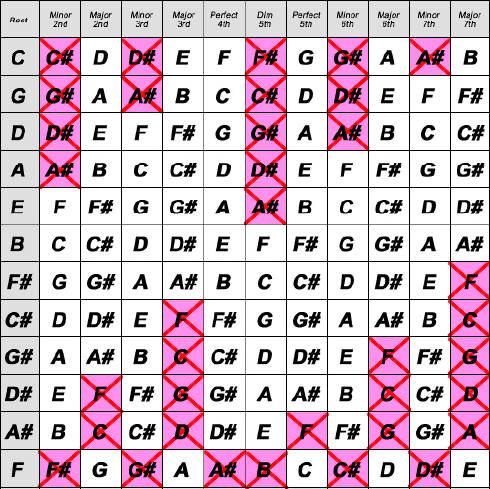
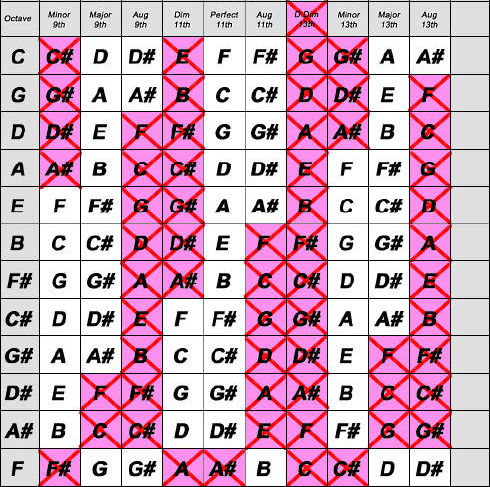
Number Correct: 156 = 62% correct
Number of Mistakes: 96
Ryan's Grade: D-
$97 bucks and 96 mistakes (so far). If you bought this course, you might want to ask for a refund.
Ryan doesn't have any clue what a Doubly Diminished 13th is, because every single one of those intervals is incorrect [see above].
Another example: Ryan's chart says a Minor 6th is "C to G#." Ryan, please know that C to G# is actually an Augmented 5th - one of many important intervals that doesn't even show on your chart. (Who needs those advanced jazz intervals anyway? ... well, everybody!) The correct interval of a Minor 6th is C to A flat.
An interval by any other name would sound as sweet?
Ryan seems to think that G# and A flat are the same tones, but he doesn't understand that in ear training and interval spelling, they are quite different.
Many people, in fact, have written to me and asked why the above 96 mistakes (in pink) are incorrect, and if it really matters. The answer is: YES, it really matters. To know the correct answers - and why you need to spell intervals properly - you have to delve a bit deeper into your ear training.
The easiest and best explanations I've heard about the importance of correct intervals are found in only one place: David Lucas Burge's Relative Pitch Ear Training SuperCourse.
The bottom line: In music, confusing a Minor 6th with an Augmented 5th is like thinking "cat" equals "kat." It shows a fundamental lack of competency with the musical language.
Ryan might like to show his $97 course manual to any high school music teacher. They still might have room for him in their class.
"Perfect Pitch Scams"
Yet the thing that disturbs me the most, and the reason I bother to post this review at all, is the way that "Pure Pitch" is hawked on the internet.
A recent Google search shows this:

The first listing is for Burge's classic and longtime respected Perfect Pitch Ear Training SuperCourse.
But what is this second listing about "scams"?
When I clicked it, I saw nothing about the "Perfect Pitch Scams" they promised in the ad, but I can see that the landing page compares Pure Pitch with Burge's method and boasts that Pure Pitch is somehow the "winner."
I also see that Ryan Cameron has built a huge network of affiliates who are all peddling his course, many of whom put these phony reviews that compare "Pure Pitch" with Burge's proven course, rating Ryan's course as the "best choice." Of course, unlike my reviews here, these people are all paid $53.23 each time you click and order.
But Ryan's sell-a-thon doesn't stop there. At EzineArticles.com I note that his affiliates have spammed over 30 "reviews" of his course in order to sell, sell and sell, all over the internet.
I guess it's easy to convince people to endorse your product as "Our Choice" if you just cut them in on the deal.
And who are these "reviewers"?
Musicians should ask themselves: who are are these people who are making these so-called expert recommendations?
The "independent reviewer" at ReviewsNest.net promises "Independent, Unbiased, Expert, In-depth product reviews." Check it out: he's also pushing an odd mix of cash-hungry courses that teach hypnosis, dog training, and Reiki.
Hmmm.
But wait, there's more...
Getting back to what Ryan audaciously attempts to teach ...
One wonders about Ryan's educational background when he comes right out of the gate proclaiming "Pitch verse Tone" (I'm sure he means "Pitch versus Tone").
After the 96 mistakes previously mentioned, things get even worse when Ryan ventures into more advanced music intervals. Listening to Ryan's course, I can hear that he has labeled a Major 13th chord as Minor 13th (those darned 13ths again). Why can't his students catch these mistakes for him and report back to him? (Maybe that's a rhetorical question.)
Ryan doesn't even understand where Middle C is located. His illustrations of Middle C are not correctly cited on the piano and guitar, which differ from the register of his sine wave example.
Enough said about Ear Training 101. As I survey his course further, I find even more advanced concerns.
Perfect Pitch is not Relative Pitch
Ryan thinks he is an ear training expert, and his "secret" is to rely on "anchor pitches" in order to identify tones.
Say what?
Yes, you heard that right: you must learn anchor pitches. This misguided method encourages you to "memorize" one pitch (your anchor), so you can then name other pitches.
The author of Pure Pitch clearly does not understand what Perfect Pitch is. His exercises seem more like some weird style of Relative Pitch contortionism.
Real Perfect Pitch does not rely on "anchor pitches" to discern other tones. You can simply know any tone by itself, without reference to any other tone.
I know this well, because I have Perfect Pitch myself. I would never dream of relating a tone to an "anchor pitch" in order to know it. I know pitches and chords immediately when I hear them, without reference to any other tone.
The very definition of Perfect Pitch is that you do not relate one tone to another. That's why it's also called Absolute Pitch, because you know the tone in an absolute sense. Relating tones is actually the study of Relative Pitch.
Perfect Pitch is not "Vocal Tension" Pitch
Next, things go even more on the wild side. Perusing Ryan's Pure Pitch manual, I discover this gem of wisdom for musicians:
When singing the note pay close attention to the way your vocal cords feel. When you visualize the note imagine you’re singing that same note, not only hearing it, but also feeling the same sensations with your vocal cords. [Source: "Pure Pitch" instruction manual by Ryan Cameron, p. 10]
Most musicians today know that judging a pitch by vocal tension has absolutely nothing to do with genuine Perfect Pitch. True Perfect Pitch is the ability to name tones by ear; it is never a judgment of how taut the vocal cords are.
The idea that Perfect Pitch could be gained by using "vocal tension" was put to rest years ago when David Lucas Burge explained the difference between real Perfect Pitch and pseudo pitch - and how vocal tension skills can never match true Perfect Pitch proficiencies (source: Burge's Perfect Pitch Ear Training SuperCourse).
In his well known Master Classes (on CDs), Burge gives a brilliant lesson on why "vocal tension pitch" is counterproductive to learning true Perfect Pitch. Burge then offers musicians his own professional secrets of how to listen, which definitely do not involve how to "pay close attention to the way your vocal cords feel."
If any of Ryan's students think they have achieved true Perfect Pitch, they may be mistaken.
Rip-Off Writing
Frankly, the Pure Pitch method is not actually worth my time to review. The reason that I bother to comment at all is to draw your attention to the way it is marketed to the unsuspecting. Musicians need to become more aware.
You should know that Ryan has ripped off his text from the web site of the #1 ear training bestseller for 30 years, David Lucas Burge's Perfect Pitch Ear Training SuperCourse.
Comparing Ryan's site to PerfectPitch.com, I find it unconscionable that he could blatantly pilfer material and take credit for it.
Compare Ryan's list of supposed benefits:
- Learn How To Name Any Note Or Chord By EAR!
- Sing Any Note From Memory Without Using A Pitch Pipe!
- Play All Your Favorite Songs By Ear!
- Compose Songs And Melodies In Your Head With Ease!
- Find Any Chord By Ear, Instead Of Searching With Your Eyes Or Fingers!
- Know The Key Signature Of Any Song By EAR!
- Improvise With Confidence, Knowing You Can't Mess Up!
- Hear Sheet Music Mentally As You Read It!
- Identify Whether A Pitch Is Sharp Or Flat By Ear!
- Increase Your Appreciation Of Music!
Compare to Burge's famous web site at PerfectPitch.com:
- NAME exact notes and chords - ALL BY EAR
- SING any tone from memory - without a pitch pipe or starting pitch
- PLAY songs BY EAR - after just listening to them
- COMPOSE music in your head
- FIND desired chords BY EAR - instead of searching by hand or eye
- IDENTIFY keys of songs - by ear alone
- IMPROVISE with ease like a pro
- HEAR sheet music mentally - in correct pitch
- KNOW if a pitch is sharp or flat - without a reference tone
- ENJOY finer music appreciation
Come now, Ryan, if you want to sell your "method," can you at least be original?
I could go on with many more examples of how Ryan steals from Burge's legacy, but you get the idea.
The thing that Ryan did not do (and cannot do) is to copy Burge's superior and proven Perfect Pitch listening drills, validated by two leading universities, that have worked for countless musicians over decades.
To wrap it up ...
Pure Pitch does not merit a second listen. One was more than sufficient to prove how curiosity killed the "kat."

UPDATE to above Pure Pitch Review:
Ryan Cameron wasn't happy with my review and has contested it. Here is what he is now telling people:
Rebuttal To Richard Bosworth's Review
Before you accept Richard Bosworth's arrogant review as gospel truth it is important we clear up any misconceptions... FACT - Many intervals have more than one name. For example, a Minor 6th is spaced 8 semitones from the root. Augmented 5th is also spaced 8 semitones from the root. They are the same distance apart! Hence the same note!
My answer back to Ryan:
Sorry, Ryan, you are again mistaken. I have marked your mistakes in red in your above quote (the word semitones is marked because you have misspelled it). Here is how your above statement could read correctly:
FACT: Each interval has only one name[!]. However, some intervals sound the same as another. For example, a Minor 6th contains two pitches, spaced 8 semitones from the root. An Augmented 5th contains two pitches, also spaced 8 semitones from the root. Hence, these different intervals have the same sounds yet different spellings. These different spellings indicate that these two intervals serve different functions in music, which is why you must learn the difference between one interval (one musical spelling) and another [Ryan, you don't seem to be getting this idea].
For Ryan to continue to argue that one can mix up intervals at will is like saying you can make up English grammar as you please. It just don't make no sense!
In fact, when he continues to insist that enharmonic spellings of intervals make no difference and can be interchanged freely at his whim, he's teaching you wrong information. It's that simple. This is music theory 101, folks. To maximize skill, knowledge and ear power, it is important that a musician learn proper intervals and correct spellings when learning ear training and music theory.